6/20/2010

Nevada - The first successfull weeks with Dan Smith!

Hi Followers,


two really busy weeks in Nevada are behind me. We did nearly every day at least one demonstration, I had to do the 100 hour service at the JCB, and we had a lot of travel in between. The first week I stayed in Yerington in a hotel without Internet, and at the moment I’m at the Super 8 Motel at Lake Topaz – and also here the Internet connection is so slow, that it is hard to upload pictures. So, I’m sorry that I can’t show you so much today.

But step by step: Last week Saturday we moved the Tractor and the baler over the Sierras – see the last post – and I went back to Reno. I had to do some things at the office on Monday morning, so that I came back to Smith Valley Monday afternoon. At the evening we baled at the first customer in Yerington – we started at 11pm and baled till 3 am. The customer who already owned two older Krone BiG Pack HDP balers was very interested to see the ‘new’ 2010 HDP in the field. He is looking forward to buy his third Krone BiG Pack HDP – but he prefers the XC (X-Cut) machine with cutter bar. Another machine he liked very much is the JCB tractor. The full suspension makes the ride in the field very smooth, and so it is possible to speed up when the windrows getting lighter. He liked the easy handling, the huge cabin with AC, radio and air suspension seat. When we had to move to the next field he asked me, if he is allowed to drive the tractor. It was no problem to me, and so he did. At the first possibility he passed his other tractor – a John Deere 7820 – and then he speeded up. When we arrived at the other field, he jumped out of the cabin and told me, that he had the whole way a smile on his face. Driving a tractor with 44 miles down the road was just incredible for him.

The next morning, Tuesday, we started at 9:30 am again, but we were only able to bale one hour before the hay became too dry. During the day I prepared the baler, and I helped our dealer Dan Smith to fix another Krone BiG Pack HDP. The next morning - Wednesday - we went to another customer also in Mason Valley to show him our baler. It was really dry when we came out there – we had only 6% moisture at the beginning and 3% moisture at the end – but we were able to bale heavy bales with 1790 – 1830 lbs (7,5 ft long). We did 64 bales before we stopped. The Customer who owns Freeman balers and older tractors was really impressed – on one hand because of the nice and smooth riding JCB tractor but also because of the performance of the Krone baler. The huge flywheel with 1600 lbs helps to make the baler running very smooth, and the tractor isn’t running like an old steam train in the field like you can see at other brands with smaller flywheels. Also the steered tandem axle helps to have a nice ride also on rough terrain or while crossing borders.


Wednesday afternoon I got some help from one of Dan Smith guys, and we did the 100 hour inspection at the JCB. Changing all the oil in the axles, the hubs, the engine and changing all the filters took us at least three hours, and so we finished that work at 6:30 pm. After we were done, I hade to prepare the baler, grease the drivelines and I filled up the twine boxes. Then I attached some new stickers on the side cover, so that everybody knows now, that we do a ‘BiG Pack Road Show’. I was done with everything at 9 pm - and the next demo was planned for 2 am the next morning. Time to sleep!


At 2 am we went out to another customer in Mason Valley to show him our baler. The first field was very good – nice windrows, and we made some really nice bales. But the second field was a mass. Small windrows with interesting hay, that didn’t spread on the pickup made it hard to make some nice looking bales. I couldn’t fill the bale chamber very well, and the bales looked like bananas. The only good thing was that the customer had the same problem with his Hesston baler. We had also suddenly some problems with our outside knotters, but Dan helped me very well to repair it very quick. The problem was that the knife arm was not able to remove the knot from the bill hook. But after some ‘adjustment work’ with a hammer and a wrench the knotters worked well again. We went to the next field, and the windrows were a little bit bigger again. That field was perfect. I could bale faster than the Hesston, and the bales were nearly the same weight like the Hesston. (The customer asked for 1600 lbs, and we did a little bit more) When we were nearly done with that field, George Kilbride, Brent Raines (both Krone Reno) and Rusty Fowler (President and Chief Executive Officer of Krone NA, Memphis) arrived at the field to see the baler in action. Luckily we had another field, and so we moved over to that place. The windrows were a little bit lighter again, but the hay speeded on the pickup and I was able to fill the bale chamber very well. Also George and Rusty tried to make their first bales with the BiG Pack HDP, and they did a really good job.


When I came back to the shop at 2 pm my first 12 hours of the day were over. I started to clean the baler again, and because of the parade at the Carson Valley Days on Saturday I decided to clean the baler with the pressure washer. I was not tired and I had time to do it. Later that afternoon we moved the baler to Wellington, Smith Valley, because the next demo was lined up for the next morning at 6 am in Smith.

When I left the Hotel in Yerington at 5 am I couldn’t trust my own eyes – it was RAINING!

The normally have no rain in the desert at this time of the year – a sentence, I heard so often the last few weeks. I moved to Wellington, and the weather at the field in Smith was better – it was dry, but in Wellington was rain again. We moved the baler to the field, and we were also able to bale – but the wet baler and the dust was not good for my clean baler and the Parade. When we were done in the field, the baler was completely dirty again. The demo was perfect again. The customer had his two Hesston balers in the field, and I made the first few windrows with nearly double speed. When I stopped to pick up the customer, he called me ‘Speedy Gonzales’. I explained him how to operate the baler and we changes seats. It took 2 more windrows, and he was also at 12 mph – double as fast as his Hesston balers. The customer liked 1600 lbs bales so I was running at only 55% plunger force and we made round about 35 flakes. When we weight some bales after the demo, we had a range from 1620 – 1760 lbs. The customer was also very impressed about the perfect bale shape and the heavy bales with nearly double speed. We made 53 bales in less than one hour with stopping in between.


When I was back at the shop, I cleaned the baler again – again with the pressure washer – and that evening I moved to Minden. I met Brent over there, and we went back to Wellington to get my PickUp Truck with the Trailer.


Saturday morning we waxed the baler before we went to the Parade in Carson Valley. Dan Smith deals also with Case and Kubota, but not with JCB, so I had to unhook the JCB. I pulled the baler with a Case Tractor at the parade, and it was really funny. It was the first time for me to drive a machine in a parade.


Sunday I had a day off, before I moved the tractor back to Wellington on Monday. We had no demonstration on Monday, but on Tuesday morning at 5 am was the next demo north of Wellington in Smith Valley. There was also a camera crew on Tuesday and Wednesday joining me to take some film shoots for a video about the Roadshow. They filmed Tuesday morning in the field and after that we made a lot of road scenes in the nearby Canyon between Smith Valley and Mason Valley. Later that day I went back to Reno because the next day we had some film shoots in the Office and the warehouse in Reno. Also the arch “Reno - the biggest little city in the World” was one place of filming. And we had some Rain and Ice-rain in the morning…..


Wednesday evening I moved back to Wellington, and we had the next demo on Thursday morning at the pivots nearby Highway 208 between Wellington and Topaz. The first time pivots for me. It’s really cool to bale the whole time in circles.


Later that day I moved the baler back to Carson Valley because we had two demonstrations that evening – starting at 11 pm – nearby Minden. I was back at the hotel by 4 am on Friday morning. Later that day I moved the baler back to Wellington, and I prepared everything on Saturday. We decided to lift the bearing between the two drivelines between tractor and flywheel a little bit, because the angle of the drivelines was really hard and there are some vibrations in the driveline. So I changed that and I did the normal maintenance like filling up the twine boxes with Krone HDP twine, greasing the drivelines and cleaning the baler.


Next week we will go down to Fishlake Valley. I don’t think that I have Internet access over there. But of course I will tell you about Fishlake Valley at my next post.


Have a good one!


Niklas

6/04/2010

Goodbye California - Nevada, here we come!

Hi Followers,

after a busy week with lots of demos I leave California tomorrow and we will go over the mountains to Nevada - Wellington, Smith Valley. Within the last two weeks we had six really good demonstrations and we baled oats, Alfalfa and wheat hay. We had rain, we had good weather, small and huge windrows - so nearly every conditions. 


But the performance of the Krone baler was very well - all the time! 
One day we baled for example together with a competitor baler in the same field. My speed was up to 16 mph, his speed was probably 9 mph, and my bales were with 1808 - 1880 lbs 300 lbs heavier than his bales (1477 - 1570 lbs)

The baleshape was perfect - all the time - and I didn't had any problems with the machine jet. Only at one demonstration the both outside knotters didn't like to work any more after 93 bales. I couldn't find a mistake and we were luckily done at the field. The next day I tried it again, and I never had any more problems after that day.


So I had a very good time the last few weeks in California - I baled in Bakersfield, Corcoran, Hanford, Turlock, Modesto and Escalon - and I hope the Customers I baled for liked our machine also very much.


It's time to say Goodbye California and Nevada, here we come!

Regards Niklas
5/23/2010

Kings County - here we are!

Hello Followers,

I'm in Kings County now, and the last days were really busy. We had 5 demonstrations and I baled two days together with 3 competitor balers in the field nearby Corcoran. And that's the first thing I wanted to tell you about. When I came over to Corcoran on Friday 14th the customer asked me, if I would like to bale that evening with him. We had changed the tractor in the morning - I run the JCB 8250 Fastrac again - and so I decided that it is a good opportunity to check all the settings and adjustments of the baler. The hitch of the JCB is a little bit higher as the hitch of the CASE Puma, and I was not sure, if it is not too high for the Pick Up. So I went out to the field in the evening, and I made some nice heavy bales side by side with the competitor balers. It was interesting for me to see the performance of the Hesston balers - they were slower and the density was not as good as at the Krone baler. This picture I took the next morning showes you very well how much more efficient the Krone baler is.
In the middle of the picture you can see a windrow the competitor baler baled. You can see 5 bales in that row. Left beside that windrow is a row I baled with the Krone baler with 1-2 mph more speed. You can see 2 bales, and one more was at the end of the windrow before.

Here another spot in the field, but the same picture - My windrow has less bales than the competitor windrow.
I also weight some bales with my balescale in the front hitch, and the results were the same like the pictures tell you:
The other bales had the following weights:
1411 lbs; 1546 lbs; 1340 lbs; 1411 lbs; 1411 lbs; 1367 lbs; 1368 lbs; 1565 lbs; 1455 lbs; 1521 lbs
Average was 1439 lbs

Our Krone bales had the following weights:
1896 lbs; 1786 lbs; 1870 lbs; 1720 lbs; 1808 lbs; 1720 lbs; 1852 lbs; 1962 lbs
Average was 1831 lbs
We made 8 ft. bales Alfalfa Hay with 8-13% moisture

It was also very nice to see the difference while baling. When the baler on my side dropped a bale, I looked how long my actual bale was - for example 70 inch in the bale chamber. When he dropped his next bale, I looked again to my monitor, and it showed me most of the time that my actual bale was 45 to 50 inch long. So I knew exactly, that I had 20-25% more material in my bale. And that with 2 mph more speed and with only 65% plungerforce. 

Here is a picture of alle balers side by side at the end of the day.

I baled there two days and all together 180 bales, before I left. Our salesman Steve Silver had lined up a demonstration on monday morning, 9am, and at 8 am it started to rain. So we had no chance to run the demo but I showed the customers the baler, all the features and I explained them the features of the monitor.
Tuesday morning it was still so wet, that we were not able to bale, but wednesday we moved to another customer to show him our baler. When I opened the front cover above the flywheel to check the oil level at the compressor I had a nice surprise.

Two days no movement, and the baler became an RV for birds. There was still another bird's nest in the front of the tractor above the front hitch. I removed everything, and we moved the baler to our next customer. He still owned two BiG Pack 1290 XC, but he was also interested in the HDP baler. We had to bale wheat hay in his field. When I arrived at the field, his rake was in the field to flip over the windrows. Perhaps it is necessary that the material dries better in the windrow, but for baling it is not very good. The windrow has more material on one side now, and when you don't give care how you feed the baler you have more on one side. The result are bad bales bended to one side, and if you use cheap twine with less knotstrengh the twine will brake on the side with more density. And that's exactly what happend to the baler and the bales of our customer and it is also the reason why he is not so happy with the balers. Perhaps the not very well maintenance of our customer is another reason for his problems.

When we showed him the HDP baler, we didn't had any problems. The HDP baler did a better job under these bad conditions, and the bales looked nice and straight. Even our customer recognized that.


Perhaps a few words about maintenance at our balers - because a good maintained machine is the key to a good operation. Perhaps this at the beginning - The Krone baler is because of it's features like the knotter cleaning system and the central lubrication nearly maintenance free.

Here you can see a picture of our simple and secure knotter cleaning system. We use air pressure we generate with a small compressor at the front of the baler if we can't get it from the air-brake system of the tractor and we blow every time before the knotter works to the important areas of the knotter. So we make sure, that the dirt and dust is not at the moving parts, when we make a knot. This system works very well when you give some care of the compressor (checking oil and cleaning the air filter daily - takes perhaps 5 minutes) and if you don't bend the airlines away from the knotter. 
And  that is nearly the whole maintenance you have to do every day. Of course, you also have to check and refill the twineboxes, but you don't have to grease anything daily. The central lubrication greases all the moving parts like plungerrollers, VFS rollers and the knotters autimatically and constantly. You only have to make sure, that there is enough grease in the central lubrication. The few manual grase points at the axle and at the drivelines don't have to be greased daily.
So, to do the daily maintenance at the Krone baler is really not a big deal. Other brands needs much more maintenance work every day!

On thursday we went to another customer, who also owned two Krone balers, two HDP from 2007 and 2008. He is the complete opposite. He maintaines his balers every day before he starts baling, and his balers are in a really good shape. We went to his field, to show him our actual baler and the Harvest Tec moisture system. It was a really good field, because a lot of regrown material made some wet spots in the hay bales, and the Harvest Tec system found them all.

This is a picture of the monitor in manual mode. On the left you can see a graph, that showes you the last 90 seconds of measurement. Every bar is 3 seconds. On the right, where you can see LO% it showes you the actual moisture contend. (under 6% is too low for an accurate value - that's the reason why you see LO% on the picture). On the left side on the bottom you see the Average of the last bale. (here 7%)
In his field we had some bars with 24 - 32% in between. And when he checked the bales with his moisture tester, he could find this spots again with nearly the same moisture contend. So, the Harvest Tec system is very accurate.

Here you can see his two balers in operation - towed by two Case Puma 165 with 145 hp at the PTO.
The last two demonstrations were at two different dairys. Both times I baled Alfalfa hay. Bothe times we had nice heavy bales and we baled with speedes from 10-13 mph. Both customers were very happy with the performance of the baler. One ownes three self propelled Freeman small balers, and the other one has two Hesston 4910 4x4 ft big balers.
It was both times at nighttime, so it was dark outside and I don't have any pictures of it. 

So far for the moment!

Regards Niklas

5/12/2010

Bakersfield - the Show must go on!

Hi Followers,

Yesterday evening we did the next demonstration here in Bakersfield. Because of the time and the darkness it was not possible, to take much pictures, but I did some few.


The location was south of Bakersfield on Old River Road nearby Highway 119. We had to bale Alfalfa Hay for the customer. I asked him before the demonstration how heavy he would like to have the bales, and he answered me "really heavy, but what is heavy? Perhaps 1200 lbs?" I decided to start with 85% plungerforce to made the first 96 inch long bales. My colleagues weight the bales directly with our small Case scale tractor and the scale showed us 1765 lbs. It was a bale with 13% moisture in average. Our customer was really surprised but also a little bit nervous if his bale wagon can load these bales, but after a call to the driver his doubts were gone and we were able to continue making heavy bales. With a speed of 8 to 9 mph one nice bale after the other came out of the bale chamber. We dropped down the plungerforce to 70%, because the Harvest Tec moisturemeter told us, the moisture raised up to 16%. We also speeded a little bit up to get less flakes in the bale, but the weight still stayed at 1700 lbs.

The customer had also his baler in the field - a Freeman 1592. The average bale weight of his baler was at 6 mph 1100 lbs. A big difference, but his baler is also not a HDP baler.
After we were done with the field after only 21 bales, he was very happy with the Krone baler. We talked a few minutes about the technics and I explained and showed him lots of details about our baler.

At the end of the day it was also a very successful demonstration, I thing the customer liked our machine very much, and when I came back today all the bales were out of the field. So the bale wagon also did a good job!

So far!

Regards
Niklas

5/09/2010

Bakersfield - the second successful demonstration!

Hi Followers,

last Friday we had another very successful demonstration. This time we were a little bit north-west of Wasco and we had to bale Alfalfa Hay. The Customer already knew the older generation of Krone BiG Pack balers, but after some problems with that machine he changed to New Holland, and now he owns two New Holland BiG Balers - one BB690 and one BB690A. Both balers were also in the same field, pulled by John Deere tractors.


We started at 10:30 am baling, and our first bale was a 2065 lbs bale (96 inch long). The only problem was that the moisture of the Alfalfa Hay was still a little bit too high (18%) so we stopped baling for perhaps half an hour. We also turned down the plunger force from 80% to 40% because the customer thought his bale wagon could have problems to lift up so heavy bales. With 40% plunger force we made bales with 1400 lbs to 1550 lbs - exactly the weight, our customer wanted to have. 


Also the moisture dropped to 9-11%, so that we were able to make pretty bales with the requested weight. Because of the rough field and the Case Puma without suspension we were not able to run the fastest possible speed. At 12 mph the tractor jumped up und down, and it was hard to stay on the seat. But the small windrows asked for more than 12 mph - much more. Sometimes the plunger hit the same flake two times because there was not enough material to feed the VFS System (prechamber) within one plunger circle. It's not such a big deal, but it shows you that you are able to go faster. The optimal speed for the baler is that moment when you have with every plunger stoke a new flake. That is also shown in the terminal - every time when a new flake is pushed into the bale chamber a small icon gets black. When it stays black, you are fine. When it becomes to get light and black it shows you that you have not enough material which means you have to go faster.


We also had our small Case tractor with the scale in the field. In addition to our bales we also weight some New Holland bales - they were at 1365 lbs. Not bad! But the New Holland balers were operating at least with half speed. Every time, they finished their first windrow we finished our second windrow. And we were operating with 40% plunger force and slower than possible because of the rough terrain and already made in average 1500 lbs bales. It's amazing to see, how well the Krone baler works.

Also the customer was very happy with the performance of the baler. He liked the cam less pick up EasyFlow, and the quiet and smooth running of the machine very much. He also complimented the nice bale shape.
After we were done I also showed him how we eject the last bales hydraulically out of the bale chamber, and he also liked that.


So the day was very successful until the bale wagon came to the field. The New Holland bales were no problem, but after he loaded the first two Krone bales (light ones with perhaps 1500 lbs) it was not possible to lift the second table. The only possibility was to collect only single bales.


So far!

Regards
Niklas

5/05/2010

Bakersfield - The Roadshow continues!

Hi Followers,

after two weeks of bad weather we have started yesterday again. Our first demo was 40 miles north of Bakersfield. Our dealer, Pioneer Equipment, is a big CASE dealer, so I also have to use a Case Puma with 195 hp. The baler here is also a different one. At the one we used in Imperial Valley we attached an accumulator, now we have one with an applicator and moisture kit from Harvet Tec.
Link to Harvest Tec

The demonstration was very successful. We made perfect bales on the hilly field out of the wheat and oat with 1450 - 1750 lbs (depends on the moisture, here we had from 9 -17%). Because of the Case without front hitch we had to use another small Case to weight the bales, but this split system is also perfect. While I bale with the customer my colleagues could weight some bales - also from the Hesston baler of the customer in the same field. He could only reach 1050 lbs at the same bale size (3x4x8ft)

Also the moisture kit from Harvest Tec works perfect too. It is very nice, when you can see in the cabin exactly how much moisture every part of the bale has. It shows you the the actual moisture in a bar chart - every bar is 3 seconds, all 30 bars together are the last 90 seconds of baling - and as an average of the last bale. We didn't use the applicator jet, but the applicator is connected to the moisture kit and works in an automatic mode.

So far!

Regards Niklas

4/25/2010

Bakersfield - Rain and bad weather last week stopped the Roadshow

Hi Followers,

last week we had some hard rain in the Central Valley, so that we were not able to run any demonstrations. They also talk about rain next wednesday, but I hope that we become better weather after that. It is really boring, when we can't run any demonstrations. Ok, I had some other work like maintanance at the JCB Tractor to do, and I also cleand up my trailer, but now I'm done with that.

At Saturday we, another service guy from Krone Spelle and me, visit our customer lambchops in the field to see his new BiG X 1000 in operation.


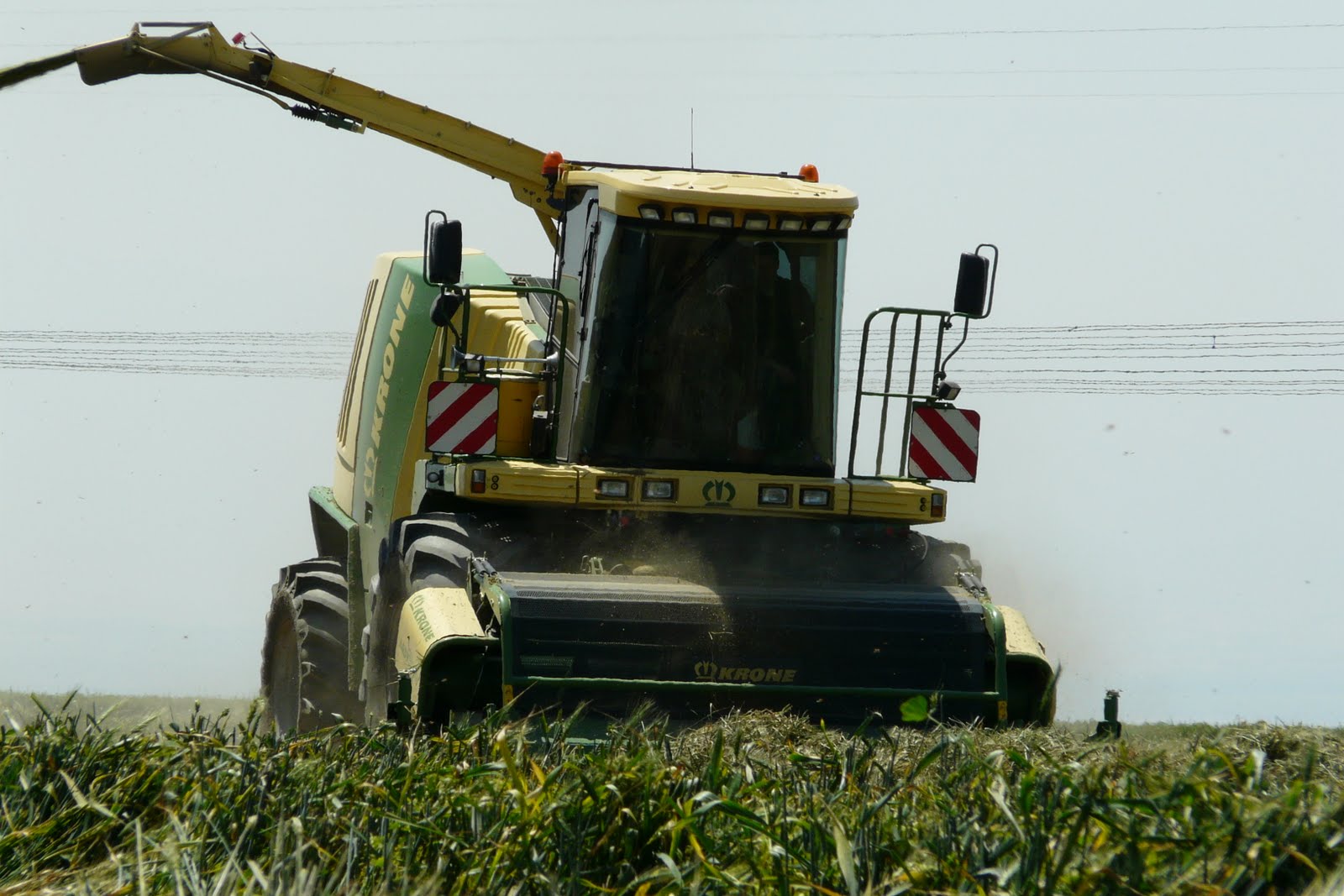
It is cool to see, how smooth and powerful the BiG X 1000 with it's 1000 hp works on the field. It also did a good job pulling out the trucks when they get stucked at the wet field. The four wheel hydraulic driven machine had no problems even with heavy full loaded trucks. The camless PickUp EasyFlow3801 made also a very good job in the heavy winter forage.
So far after a week without baling!

Niklas